Home

1967-1968

Bloody War

Tet Offensive

Phuoc Dien

1968-1969

Division Commander

A Shau Valley

1969-1970

Highway to Quang Tri

 
  1970-1971

Imperial City of Hue

Company HQ - Phu Bai

Bob Hope USO Show

A Shau Valley Operation

1971-1972

Lineage and Honors

redeployment


History

Alpha Company, 2nd/501st 101st Airborne departed from Fort Campbell, December 1967. Members of the Advance Party departed between the 17th and 24th of November 1967. The battalion deployed to Vietnam on 13 December with the exception of a twelve-man rear detachment which followed on the 16th and 28th of the month.

The battalion flew into Bien Hoa and then moved to Cu Chi by truck convoy. They remained at the 25th Infantry Division base camp for thirty days of in-country training. In January of 1968 Phu Bai became the new AO.


Alpha Company - Ft. Campbell, Ky. 1967


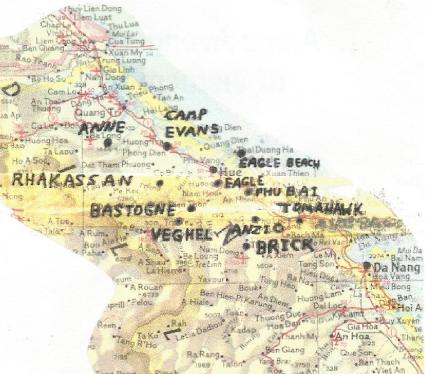
I-Corps was A Company's AO (Area of Operation) in Vietnam. This area had the most intense fighting and the highest casualty figures. 53 percent of all American combat deaths occurred in I Corps. Quang Tri, Quang Nam, and Thua Thien Providences accounted for 40 percent of all American deaths.


In 1959, President Dwight D. Eisenhower undertook action to maintain South Vietnam as a separate national state after the French abandoned their efforts to maintain control over Vietnam. In 1963, President John F. Kennedy gave a supportive nod for a military coup that toppled South Vietnamese President Ngo Dinh Diem, but was deeply disappointed when Diem and his brother were assassinated. In 1964, after North Vietnamese patrol boats attacked a US Destroyer, Congress passed the Gulf of Tonkin Resolution giving President Lyndon Johnson broad authority to support South Vietnam in their effort to maintain their independence from North Vietnam.

In 1965, the First Brigade (1/327, 2/327, 2/502) of the 101st Airborne Division landed at Cam Ranh Bay anxiously in search for its "rendezvous with destiny". At the end of 1967 and early 1968, the rest of the 101st Airborne Division (the Second Brigade including A Company, 2/501 and the Third Brigade) landed at Cam Ranh Bay and moved to Bien Hoa just north of Saigon. After just a few weeks, the Second Brigade moved to I Corps near the Imperial Capital of Hue just shortly before the Tet Offensive of 1968 (January 30th). The rest of the Division moved to I Corps just two weeks later and set up headquarters at Camp Eagle.


back to top


BLOODY WAR


First Combat Mission Makes Men Of Boys
By DON TATE, Scripps-Howard Staff Writer

 CU CHI, South Vietnam - Up until now it had all been play war.

The green paratroopers, only two weeks in Vietnam, would run down the dirty road toward chow, and a sergeant would bark things like: "Hey, you animals, let me hear you growl…” And they would go "Rowwwr ...”

Arise For Orders

But this morning the men and boys of Alpha Company came out of their tents early, slowly formed into platoons, and waited for orders from their company commander, Capt. Dave Reiss of Alexandria, Va.

This was the morning they were going to war, their first combat mission - and for some of them, the last.

I moved among them, talking to one, then another.  There were hard swallows, tight smiles, and very little of the famous airborne wisecracking.  Some admitted they bad not slept the night before.

Capt. Reiss had told me that though Alpha Company was part of the 2nd Brigade of the "Screaming Eagles" of the 101st Airborne, about 60 per cent of his men weren't hardcore paratroopers.  Many had been mustered up hastily from truck driver or company-clerk jobs after the brigade had received orders back at Ft. Campbell,  Ky.

"But they've turned into a good outfit fast," Capt Reiss said.  "Still, you never know until you've been shot at.“

Worries About Pigeons

One who didn't seem particularly nervous about it was the baby-faced Georgia lieutenant who commanded the weapons platoon. He smiled and said he was really more worried about the carrier pigeons he was training.  He didn't like leaving them alone.

Another who didn't appear in mortal terror was his big, laughing Negro platoon sergeant from Kentucky, described by his commanders as not just a good soldier, but a “great” soldier. He and Capt. Reiss were members of the small nucleus of combat veterans in the company who volunteered to return for a second tour in Vietnam.

One who didn't mind admitting he was nervous was 2nd Lt. John Rodelli of Chicago. Lt Rudelli, small, swarthy, intense, said he know how he was going to react or how his platoon was going to react. Only six months before, Lt. Rodelli had been taking ROTC and majoring in business management at college.

Another nervous one was 18-year-old Pfc. Larry Mize of Baltimore, an impish-faced medic with a missing front tooth.

"I've got a false one," he sort of stammered, pulling the tooth from his pocket, "but I don't wear it when I'm walking.  It gives me a headache."

Pfc. Mize said he became a medic because he figured it might do him some good when he “got out.  And maybe while I'm in…”

"New Ball Game"

Sgt. Dave DuBose of Birmingham, Ala., said sure he was an 18-year veteran and had been under artillery fire in Korea, "but this is a new ball game."

At 8:30 a. m., Capt. Reiss gave the order: "Right about face!" Then: "Move out in a column of fours."

Alpha Company was part of a battalion search-and-destroy sweep north from Cu Chi toward the Ho Bo Woods about 35 miles northwest of Saigon.  The company platoons went out in three horseshoe-shaped formations from the camp.

"Get that rifle off your shoulder," someone bellowed to a soldier in the point platoon.

"What do you think you've got there, a. bag of oranges?"' hollered a squad sergeant to a private carrying extra ammo clips in one hand in a sack.  "How you going to fight like that, soldier?"

"Here it starts," said Lt. Rodelli, popping a magazine in his M-16.

6 Hours, No Enemy

It started and went on for six hours.  We moved, watching for booby traps, guns ready, and kept going through blistering-hot, thorny, thick-brushed, broken-treed, insect-swarming flatlands.  We found plenty of enemy tunnels, but no enemy.  The heat knocked out a couple of troopers who had to be evacuated, and the big black and red ants seemed to want to eat you alive; but it was all tension and bull labor, no fighting.

By the time the company moved into a grassy stretch where they would dig in for the night, the tension and grimness had been sweated out.

They plopped down their packs and rifles, stripped off their shirts, drank deep from canteens, got out entrenching tools, started digging in the sun-baked ground and filling up sandbags.

"Is this piece of nothin' what we been marching for all day?" laughed a soldier, looking around.

"That's war," kidded another.

Start Off For Briefing

Lt. Rodelli asked if I wanted to go over to the briefing for the night ambushes, and I said I did.

"We'd better go a little early," he said.  "I'm not sure where it is.”

Beyond our perimeter now, about 500 yards out, came artillery bursts-it was our stuff back at Cu Chi zeroing in our position in case of an enemy attack during the night.

We walked through the weapons platoon where the baby-faced Georgia lieutenant was holding forth as casual as ever, probably still worrying about his pigeons.  His platoon sergeant, the "great" soldier, was laughing and demonstrating digging to the greenies.

They say you never hear the one that gets you.  I heard this one.  It came down behind us hissing and my head already was down and touching ground before the explosion.  That bursting, shocking sound came and the concussion went smacking over us.

Someone to my left was saying: "What the devil, what the devil .. (and then the voice was furious, unbelieving) "That was one of ours!"

Another Explosion

There was another explosion farther away, and I heard the same voice yelling: "Tell that damned artillery to cease!"

In a moment I looked up and saw the black cloud from the first explosion barely 30 yards away.  It hung over the weapons platoon.  All around men were shouting: "Medic!  Medic!" And at the same time there came screams, ungodly screams.

I stood up. Behind me a tall soldier was stretched out flat in the high grass.

"Are you hit?"

He just lay there rigidly flat in the grass.  I bent over him and he stared straight at me blinking his eyes furiously.  He wasn't hit. He was scared literally stiff.

I ran toward the smoke and stepped on something.  It was a man's arm, severed at the elbow.

Belonged To Lieutenant

The man the arm belonged to lay in the dirt and smoke.  It was the baby-faced lieutenant.  His eyes and mouth were wide open as though he had died shouting.

A few yards away was the "great" soldier, who had been laughing and demonstrating digging moments before.  He lay on his back on a bloody hump of earth without his head, with his left shoulder and arm blown away.

In the next nightmarish minutes I saw Pfc. Mize, the young medic, working among the blood and bowls as though he had been a doctor all his life.

Radiomen were calling evacuation choppers.  Capt. Reiss and Lt. Rodelli were both moving quickly, directing their men. Others were trying to identify the dead.  One man kept saying he had to find the sergeant's head. Another picked up the lieutenant’s arm and wrapped it up with him in a poncho.

Five soldiers worked with morphine and bandages over a man whose leg was hanging off.  They had to keep knocking away huge ants.  Nearby, ants were swarming over a helmet spattered with blood and flesh. The helmet had "Tennessee" penciled on it.

Count Four Dead

Between then and the approximately 25 minutes it took the first chopper to reach us, we counted four men dead, two more close to it, and eight others wounded. It was also determined (and later verified) that one of our own potent 4.2-inch mortar rounds from out of Cu Chi had fallen short by mistake.

One man stood looking down and said over and over, fighting back tears: It's a helluva thing to happen.  It's a helluva thing …” Another just said: "Damn, damn …”

Lt. Rodelli stood nearby, shaking his bead.

Pfc. Mize came over to Capt. Reiss. The kid's hands were bloody to his wrists, only he didn't look like a kid anymore.

“Those guys had wives and children,” Sgt. DuBose was saying. “ They were good men. “

"The best," the captain said softly. “The very best."

Alpha Company had reached the war.

- The Pittsburgh Press, Sunday January 7, 1968


back to top


TET OFFENSIVE OF 1968


Operation Jeb Stuart

The 2nd Brigade, 101st Airborne Division (including A Company, 2/501st) teamed with the 1st Air Cavalry Division and the renown ARVN 1st Infantry Division in Operation Jeb Stuart. Landing and setting up on the Phu Bai airfield, the 2nd Brigade moved north to LZ Sally. 

On January 30th, the outbreak of the Tet Offensive, the Brigade continued to  move north and joined the heavy fighting in the battle for Quang Tri with the 1st Cav. 

After Quang Tri was cleared, the 2nd Brigade and the 1st Cav moved south to set up blocking forces in the countryside around Hue, while US Marines and ARVN forces fought to retake the city from the NVA. The 2nd Brigade cleaned out pockets of enemy resistance between Hue and Quang Tri and intercepted NVA units atempting to reinforce the former Imperial City.


back to top


PHUOC DIEN

On April 10th, A and D Companies were sent to verify the reported presence of two enemy companies entrenched in strong defensive positions in the village of Phuoc Dien. In short time, both companies were pinned down and in heavy contact. It soon became obvious they would be unable to take the village without suffering heavy casualties and they would need additional reinforcements.

General Barsanti, the Division Commander, ordered the companies to "stay with the enemy" and agreed to send them whatever they needed -- which in this case was extra helicopters to bring in reinforcements. LTC Tallman, the battalion commander, moved B Company into the fray, and by nightfall had succeeded in completely surrounding the village. American positions were established no more than ten meters apart. LTC Tallman ordered 100% alert during the night as well as continuous illumination by flare ships and artillery. 

Between 2000 hours that night and 0730 hours the next morning, the trapped NVA made at least 12 separate attempts to break out of the village. The next morning, 36 NVA soldiers were found dead within hand-grenade distance of the American positions. Two dazed NVA were captured and taken prisoner. At 0800, companies B and D assaulted the village in a coordinated attack that met only moderate resistance. When the smoke and dust had cleared, the 2/501st had killed 70 NVA and captured 13.  


back to top


DIVISION COMMANDER VISITS ALPHA COMPANY


Lucky Eagle Sez

By MAJ. GEN. MELVIN ZAIS 

Division Commander


I try to talk to as many men as possible as I travel throughout the Division area. It isn't as though I were running for office. An Army is not inherently a democratic institution and we don't vote to arrive at decisions. However, I do learn things and it does help me to run this Division better, if I listen to young soldiers, young and old sergeants and young officers. Being one of them myself, I usually know what the old officers are thinking. 

On Monday, 3 February, I had an uplifting experience. I was able to find a place to sit my chopper down with A Company, 2/501st Infantry, commanded by Captain Mayer. The company had been "humping" through the mountainous jungle without a break since 18 January. It was raining lightly. The company was spread out in a grassy clearing and I was able to stroll among the platoons and chat with every man. 

I wish I could describe it to those at home. Clear eyed men smelling very strong of days on end of honest sweat. Hands hardened, swollen, scratched and strong. All faces, despite the fact that my visit was a complete surprise, freshly shaved. All weapons shiny clean. Each man looked me in the eye as he talked. All were very proud of the unit. Many had been with the company for less than two months, some for almost a year. There were men from Indiana, New Jersey, Texas, Arkansas, California and Connecticut. There were Puerto Ricans and Mexicans, Blacks and Whites, college graduates and high school drop outs, farm and city boys. All were welded together in a common bond of achievement, self sacrifice, physical discomfort, fear, survival and most of all, pride-pride that only a man who has overcome hardship and suffering and fear can understand, pride that makes the most important of considerations the good opinion of the rest of the men in the squad, platoon and company. 

It is here that one senses the moral fibre of the men of our Army, which is a cross section of our Nation. It is here that one renews faith and confidence and trust in the future of our country. It here that one drinks at the well of sweat and sacrifice and is refreshed. 

The company I saw is a good one. It is, however, not alone. It is one of many. Each day as I see you and talk to you I gain further respect for your soldierly qualities and I am proud to lead the Screaming Eagles.

Screaming Eagle, February 24, 1969


back to top


A SHAU VALLEY


During March and April of 1969, five battalions of the 101st Airborne Division including A Company and the rest of the 2/501st, air assaulted into the A Shau Valley.  Combat assaults and fast moving reconnaissance in force quickly determined the NVA were avoiding contact and moving its main forces back across the border. The operation yielded many large caches, one that included 14 trucks, 600 brand new SKS rifles, ChiCom radios and field telephones.


back to top


COMMUNISTS CUT OFF HIGHWAY TO QUANG TRI


Communists Cut Off Highway to Quang Tri

Communist forces cut the highway lifeline to Quang Tri today, preventing South Vietnamese reinforcements and supplies from reaching the endangered city. A 600-man South Vietnamese battalion was sent to try to dislodge the North Vietnamese and reopen the road. 

North Vietnamese forces also continued the heavy shelling, followed by some ground attacks, against Firebase Bastogne 15 miles southwest of Hue. Bases Anne and Bastogne were the major northern defenses to Hue, South Vietnam's third largest city. Communist forces Tuesday prevented a South Vietnamese relief column from reaching Bastogne. 

American B52s continued their high-level bombing in an effort to ease Communist pressure on Quang Tri, which now is open on all sides to the Communists but which so far has not come under major attack. However low-lying clouds once again held down low-level bombing and straifing runs to a minimum. 

Informed sources in Washington said more B52s, probably about 18 of them, were being rushed to Southeast Asia to help in the battle. 

The U.S. command in Saigon said that "several" Americans have been killed or wounded during the six-day Communist offensive in the Quang Tri province, but said no details could be made available until after next of kin were notified. So far U. S. officials have acknowledged that six American aircraft were shot down, claiming three wounded and 12 missing. However, military sources said other American casualties have occurred, including some among the estimated 65 U.S. advisers in Quang Tn and in unreported downings of U.S. aircraft.

November 1969


back to top


Imperial City of Hue


The Imperial Capital of Hue was the third largest city in South Vietnam, behind Saigon and Danang.   


back to top


Company HQ - Phu Bai


  Captain Zimmerman, A Company Commander
     

  First Sergeant Angel Carrero (Top on right) never forgot that his company was out in the jungle and kept us well supplied.. 
     
  Heavy rains, a common occurrence, formed streams of mud between bunkers.
     
  It was not McDonalds, but the GI snack bar tried to bring a little fast food to Vietnam.


How did you pay for your hamburger at the GI snack bar? MPC's -- GI funny-money


back to top


Bob Hope USO Show


Baseball great Johhny Bench


"Drive On" Troops Journey to Hope

FIREBASE TOMAHAWK - It isn't as significant as Plato’s allegory of the cave. It isn't as long as the journey of progress of Bunyan's pilgrims. And it will probably never gain fame as an exodus. But the story of the faithful trek of a small group of soldiers from the 101st toward the lights of Firebase Tomahawk, enroute to Hope, ended with charity.
Though the Yuletide season is past and Bob Hope and his crew have gone, 15 men of Co. A, 2nd Bn. (Ambl.), 501st Inf. will never forget the show.
"We know Bob Hope is being thanked by a lot of people, officials and representatives," said SSG Mark Hawk, Lafayette, Ind., “but we just wanted to write to him and let him know that we’ve adopted the motto: ‘We’d walk miles for Hope.’” And they did.
“The day before the show, we received the message that we were going,” explained SP4 Wilson Scheirer, Whitehall, Pa. “We weren’t near a landing zone (LZ), so we couldn’t get a ride back to the firebase on a helicopter.”
In late afternoon the platoon started the slow three-mile journey through thick jungle across streams, and over mountains. At dusk, they set up a defensive position in a bomb crater.
With two miles to go through thick vegetation, and with the fog setting in, limiting visibility to a few feet, the crew was on the move before dawn.
“So that we could keep track of each other and not get separated, we put shiny-backed leave on every man’s rucksack,” said PFC Mike Nehl, Lemmon, S.D. The luminous-backed leaves grow wild on low shrubbery in the mountains.
After hours of chopping and trudging, the men heard the sound of trucks traveling on Highway QL-1, near Firebase Tomahawk.
“I called the firebase on the radio,” said SP4 Scheirer, “and told them I could hear them, but couldn’t see them because of the clouds.” Within a few seconds the firebase came to life, truck lights blinking and horns sounding to guide the crew in.
The men got front row seats and considered the singing of “Silent Night” as the highlight of the show. “I think we’re all looking forward to calm silent nights, concluded PFC Nehl.

Screaming Eagle, Feb 71


back to top


A Shau Valley Operation


  Members of an infantry company are being airlifted for an air assault into an area near the southern tip of the A Shau Valley. The operation is a joint operation with the 2nd Battalion, 54th Regiment, Army of the Republic of Vietnam.
     
  A Huey brings supplies. The LZ (landing zone) is cut in the jungle in a low spot not preferred by pilots. The helicopter blades present a danger to the troops unloading.


back to top


Eagle Beach


  Orderly Room, Eagle Beach. Eagle Beach was established on the South China Sea six miles east of Hue in May of 1969 for in country Rest & Relaxation (R&R). A Company was sent to Eagle Beach to recuperate for several days after suffering major casualties due to contact with the the North Vietnamese off Firebase Veghel.
     
  But even on R&R, you can't completely escape the realities of war. The perimeter around Eagle Beach was guarded including the beach.
  Sunrise over the South China Sea at Eagle Beach.
  Colorful "hooches" line the beach at Eagle Beach.


back to top


LINEAGE AND HONORS


REDEPLOYMENT


The 101st Airborne Division began its redeployment from Vietnam in November 1971. The Division turned over Camp Evans, LZ Sally and Camp Eagle to ARVN units, withdrawing to Phu Bai, and finally to DaNang to close-out of Vietnam. The Screaming Eagles were the last US Army division to leave the combat zone in South Vietnam. Finally, a single color-bearing battalion-sized element departed DaNang by plane for Ft. Campbell, Kentucky, in March, 1972.


back to top


Webmaster - Barth "Shortround" Cunico
Copyright © 2007 by [www.alphaavengers.com]. All rights reserved.